

And Why Other Universities Are Taking Notice
When Texas A&M’s Mays Business School faculty started looking like ghosts on camera, the school knew it had a problem.
Under harsh fluorescent ceiling lights, professors appeared washed out, hair stood on end, and shadows fell across faces in all the wrong places. The distance learning experience was undermining the school’s reputation for excellence.
The solution came through a complete studio overhaul using Power over Ethernet (PoE) lighting—a move that eliminated permit delays, reduced infrastructure complexity, and positioned the business school as a campus leader in educational technology.
Today, Jeff Jones—the Executive Director of Teaching & Learning Innovation who led the transformation—fields questions from other departments across Texas A&M: “How are y’all making these studios affordable?”
This is the story of how nine studios went from liability to competitive advantage, and what system integrators and educational institutions can learn from the transformation.
The problem: When your studio makes faculty look worse than Zoom at home
Before the upgrade, Texas A&M’s distance learning setup relied on makeshift studios with fluorescent ceiling lights in rooms never designed for video production. Jones found himself manually adjusting light bulbs—rolling them one way or another to create some semblance of proper lighting. The results were predictable: shadows, poor visibility, and faculty who dreaded appearing on camera.
Amy Hurta, a CPA and accounting lecturer who teaches through the Flex Online program for working professionals, experienced these challenges firsthand:
“The only lighting that we had was the fluorescent overhead lighting. And it was not kind to anybody. I know I’ve earned the wrinkles on my face, but we were just highlighting those.”
— Amy Hurta, Lecturer, Mays Business School
The harsh, top-heavy lighting created unflattering effects across the faculty. Hurta describes colleagues “literally scratching their heads going, this doesn’t look right.” One professor told Jones repeatedly that he looked “like a ghost” on his video.
Virtual backgrounds presented their own issues. The washout effects meant particular problems with diverse hair types—the lighting simply wasn’t designed for professional video production.
The credibility problem
For a business school teaching professional communication skills, the studio quality created an uncomfortable disconnect. Hurta, who covers topics like virtual presence in her accounting communication courses, found herself in an awkward position:
“You feel a little bit hypocritical talking about some of these important issues in virtual presence when you know that the studio is not on par to meet those needs. If we say that we’re teaching from a professional studio, it should also have that professional studio feel.”
— Amy Hurta
Perhaps the most telling sign: faculty could actually look more professional teaching from home than from the institution’s own studios. For a school pursuing a “preeminent” mandate from Dean Nate Sharp, this gap needed to close.
The competitive advantage question
Jones understood that convincing faculty to use studio spaces meant offering something they couldn’t replicate elsewhere. Faculty who were paid and volunteered to teach in these spaces often thought they could achieve similar results from home or their office. When they were told to come to a studio, Jones needed to demonstrate clear value.
Hurta framed the goal in practical terms:
“When you look at a LinkedIn Learning video, it’s an effective production, right? It looks polished. It looks professional. It looks put together. And you can’t do that on your own with a laptop camera.”
— Amy Hurta
That LinkedIn Learning standard became the benchmark. The question shifted from “Can we make this functional?” to “Can we make this genuinely professional?”
The PoE solution: How network drops replaced electrical outlets
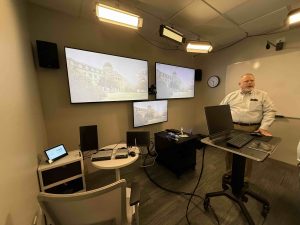
Working with partner Texas Film Gear, the business school implemented PoE lighting systems across nine studios. The technology delivered power and control through single ethernet cables, eliminating the need for extensive electrical work.
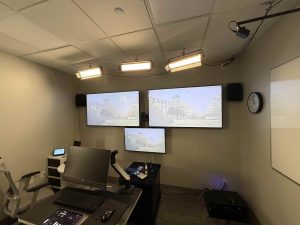
The implementation included PoE lighting arrays providing professional-quality illumination, dedicated hair lighting to separate talent from backgrounds, dual gallery view Zoom Rooms supporting up to 90 students simultaneously (45 per screen), and Sidus Link Pro software for lighting control.
The infrastructure decision proved strategic for the leased facility. As Jones explained, utilizing network drops instead of electrical outlets made more sense—running extensive electrical outlets wouldn’t serve future tenants if the school eventually moved.
Each studio session now begins with a 30-minute setup period where lighting is customized for individual faculty members, accounting for clothing choices, hair, and personal preferences.

The transformation moment
When Hurta walked into the upgraded studio for the first time, the difference was immediate:
“I walked in and I was just thrilled. Finally, we have lighting. It’s nice because it was coming around at different angles and we could toggle how intense it was depending on personal preference or what’s going to look good. The lighting immediately made everything feel less harsh.”
— Amy Hurta
The multi-angle, adjustable approach addressed the core problems. Faculty could see themselves through preview monitors and make quick adjustments, confident the lighting would flatter rather than undermine their professional appearance.
The producer model: Why diverse backgrounds make better studio teams
 A key innovation in the Texas A&M approach is the use of “instructional technologists”—nicknamed producers—who manage all technical aspects during recording sessions. This frees faculty to focus entirely on content delivery.
The producer role demonstrates remarkable accessibility. The team includes professionals from diverse backgrounds: a former makeup artist with marketing experience, a customer support specialist, a 25-year English teacher, IT professionals, and operations technology specialists.
Jones emphasizes the achievable nature of the role: “If I can do it, anybody can do it. But I also say, if it were easy, anybody could do it.” The business school provides comprehensive onboarding with shadowing, mentoring, and buddy systems before producers work independently.
From the faculty perspective, having a producer fundamentally changes the experience. The cognitive load before a cohort session is already substantial—thinking through content, reviewing graded work, considering where students are in asynchronous modules. Having someone else handle technical setup removes that burden.
Measurable results: What changed after the upgrade
Faculty confidence and performance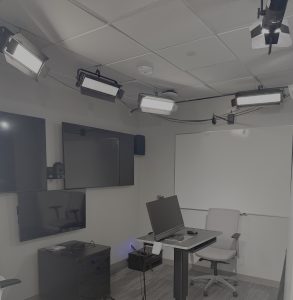
The lighting upgrade directly impacts faculty performance by reducing cognitive load and increasing confidence. Hurta noted:
“It does help with confidence when you know that the little icon of you right there, you don’t have that harsh, whether it’s hair, little frizzies flying up or just the harsh shadows on your face. If you look polished, it helps.”
— Amy Hurta
This confidence translates into better teaching. When faculty aren’t worried about their appearance, they can focus on what matters: connecting with students and delivering content. As Hurta explains, the purpose of live cohort sessions is “to build those relationships, to pierce the virtual barrier. We’re in this together. We’re here together.”
The “flip the switch” effect
The studio environment creates a professional mindset that’s difficult to replicate elsewhere. Unlike teaching from home, where distractions can diminish energy, the studio provides a protected space for peak performance:
“There is something different about when you step into the studio. It’s a little bit more flip the switch, step into gear. You’re a little bit more on point versus when you’re at home. At least when you’re in the studio, you can be on your feet. You have some movement, you’re not stuck in a chair for an hour and a half.”
— Amy Hurta
Campus-wide recognition
The transformation’s success became self-evident. “The lighting did the speaking for me,” Jones emphasizes. When expanding from two pilot studios to nine total, the results were compelling enough that no additional justification was needed.
The studio upgrades have generated significant interest across the university. “We’ve already had other business units at the school, other areas such as the Bush School and the libraries coming to look at us,” Jones says. “They’re asking, ‘How are y’all doing this? How are y’all lighting this? How are y’all making them affordable?'”
Modeling professional standards for future business leaders
The Texas A&M implementation represents more than a technical upgrade—it’s a statement about educational standards. For a business school preparing future leaders, the quality of the learning environment sends a message about expectations.
Hurta articulated this perspective:
“If we’re communicating to them, what are the skills you need to be a professional? What are the leadership aspects or the communication skills? We’re modeling to them that behavior. All of that is showing them what is the expected quality. If we’re too low, that’s not going to prepare them.”
— Amy Hurta
Students are “wowed by the product,” while faculty can deliver content with confidence. Jones sees this as essential for preparing future MBAs: corporations will need similar technology, and training students on professional production standards means they’ll bring those expectations to their future management positions.
The XR roadmap: Where Texas A&M is headed next
Texas A&M’s vision extends beyond current capabilities. By 2029, the business school plans to convert eight of their nine studios into extended reality (XR) stages. This positions them at the forefront of immersive educational technology.
Jones articulated the forward-thinking rationale:
“You think about corporations, how they’re going to train. Well, they’re going to start using XR, or they’re already starting using XR. If we don’t start elevating our game and bringing it to preeminence, we’re not leaving a legacy with our students for them to take into the business world.”
— Jeff Jones, Executive Director of Teaching & Learning Innovation
Hurta summed up the requirement simply: “With a studio like that, we have to have good lighting.”
The plan includes morning and afternoon production shifts to maximize studio utilization and integration with new programs like sports analytics.
How this compares: Other education deployments
Texas A&M isn’t alone in turning to PoE lighting for educational environments. Several other implementations provide additional context for system integrators and institutions evaluating similar projects.
Gwinnett County Public Schools (Georgia)
This school district is deploying broadcast studios across 40+ schools. Fire marshal regulations prohibiting traditional floor-based power cables made PoE the only viable option. The district avoided 6-12 months of permitting delays per location while maintaining 100% fire code compliance through the low-voltage solution.
As one Ikan sales leader explained:
“Fire marshals will rip out any floor-based extension cables. PoE is the safe option—low voltage, it’s music to their ears.”
University of Missouri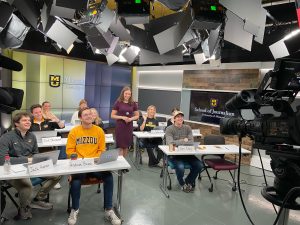
The School of Communications faced a five-day installation window during Thanksgiving break. With no existing ceiling power infrastructure and no ability to disrupt academic schedules, PoE allowed complete studio deployment during the holiday window. The installation was fully operational before classes resumed.
Orange County Public Schools (Florida)
This district represents one of the longest-running educational implementations, spanning 197 schools (133 elementary, 41 middle, and 23 high schools). The evolution from fluorescent fixtures to LED to full ecosystem adoption demonstrates how educational investments can scale over time. Custom SKUs were developed to meet budget requirements across the diverse school environments.
What system integrators should know
For SIs working with educational clients, several factors from these implementations stand out.
PoE lighting reduces project risk by putting all factors within SI control. Traditional electrical work involves coordination with contractors, permit timelines, and variables outside the integrator’s direct influence. When delays happen with traditional installations, customers don’t care whether the SI or the electrician caused the problem—they just want the project done on time.
The installation simplicity creates new opportunities. Projects that previously required SI plus electrician plus contractor coordination can be handled by the SI alone. This can improve margins while reducing complexity.
Standardized configurations enable repeatability. The “Happy Meal” approach—standardized packages that can be deployed consistently across multiple locations—reduces design time while ensuring compatibility. SIs can train junior staff on standardized deployments rather than custom engineering each room.
Single-vendor accountability matters for educational clients. When something goes wrong, schools want one number to call. Integrated solutions from a single manufacturer simplify support relationships.
Key considerations for educational institutions
Budget and timeline
PoE lighting eliminates the $6,000-$20,000 permitting costs typical of traditional electrical installations. The 75% reduction in installation time (one day versus three to four days for traditional approaches) means less disruption to academic operations.
For institutions in leased facilities, avoiding permanent electrical modifications preserves flexibility. Network infrastructure already exists in most educational buildings, making PoE a natural fit.
Fire code compliance
Low-voltage DC power through ethernet cables satisfies fire marshal requirements that prohibit floor-based extension cables in many jurisdictions. This compliance comes built into the technology rather than requiring additional engineering.
Operational sustainability
The producer model demonstrates that non-technical staff from diverse backgrounds can be trained to operate professional studio environments. Two-week onboarding programs with shadow and mentor systems can build capable teams without requiring broadcast engineering backgrounds.
Future-proofing
Investments in IP-based infrastructure support future expansion. Studios built on network technology can evolve toward advanced capabilities like XR production without starting from scratch.
Key takeaways
The Texas A&M implementation demonstrates several principles applicable across educational environments:
- Professional lighting directly impacts faculty confidence and teaching effectiveness. When instructors aren’t worried about how they look on camera, they focus energy on student connection and content delivery.
- PoE technology removes infrastructure barriers. Permit delays, electrical costs, and lease restrictions become non-issues when lighting runs on network infrastructure.
- Studio investments can build competitive advantage. Faculty who have access to professional production environments can deliver content that rivals commercial educational media.
- The producer model democratizes studio operations. Diverse teams with comprehensive training can operate sophisticated broadcast environments without specialized technical backgrounds.
- Planning for future technology pays dividends. Infrastructure built on IP standards can evolve toward emerging formats like XR without complete overhaul.
Technical specifications: Lyra PoE lighting products
For those evaluating specific products, the Lyra PoE series used in educational implementations includes several configurations: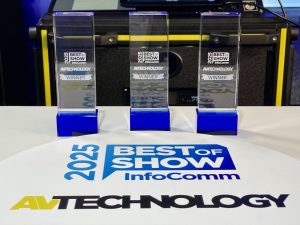
LBX8-POE — 50W PoE++ low-profile soft panel
- Bi-color adjustable 3200K-5600K
- 97 CRI COB LEDs with 1/2 stop soft diffusion panel
- Art-Net and sACN DMX-over-IP control
- Q-SYS compatible
- Low profile for spaces with low clearance
- 110-degree beam angle with built-in barndoors
LBX10-POE — 85W PoE++ 1×1 soft panel
- Bi-color adjustable 3200K-5600K
- 97 CRI rating
- Silent fanless operation with Art-Net, sACN, or DMX512 control options
LBF60-POE — 60W PoE++ Fresnel
- Bi-color adjustable 2700K-6500K
- 97 CRI
- 30 or 60 degree fixed angle options (zoom capability available with LBF60Z-POE)
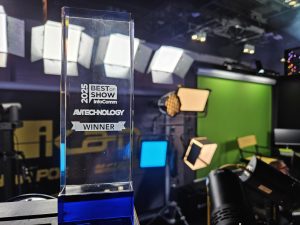
These products won AV Technology’s Best of Show at InfoComm and the Higher Ed AV Awards Silver Award, recognizing their design for educational and professional environments.
For more information about PoE lighting solutions for educational environments, book a chat with an Ikan pro.
Resources and further reading
For those exploring distance learning studio development or PoE lighting implementation, these external resources provide additional context:
Institutions referenced in this article:
- Texas A&M Mays Business School — Home of the nine-studio distance learning transformation and Flex Online MBA program
- Texas A&M Bush School of Government and Public Service — One of the campus units now exploring similar studio implementations
Technology and integration:
- Q-SYS by QSC — The AV control platform integrated with Ikan PoE lighting for one-button studio activation
- Art-Net protocol — The lighting control protocol used for DMX-over-IP communication in networked studio environments
Industry standards and associations:
- AVIXA (Audiovisual and Integrated Experience Association) — Industry association for AV professionals, including resources on educational technology integration
- EDUCAUSE — Higher education technology association with research on learning space design and distance education trends
- InfoComm Trade Show — Where Ikan’s LBX8-POE won AV Technology’s Best of Show award
Technical reference:
- IEEE 802.3bt (PoE++) Standard — The Power over Ethernet specification enabling 60W-90W power delivery through ethernet cables