

Real Numbers From Actual Deployments
A single pilot room at Texas A&M became 13 distance learning studios. Gwinnett County’s initial 23 locations expanded past 40. Orange County Public Schools now runs broadcast equipment in all 197 of its schools. What made this kind of rapid scaling possible—and why does it matter for organizations evaluating studio investments in 2026?
The debate over whether professional broadcast technology can work outside traditional TV stations ended in 2025.
Not with announcements or trade show demos, but with deployment numbers that tell a clear story: simplified, IP-based studio solutions scaled across education, corporate, and specialized sectors at rates previously associated only with IT infrastructure rollouts.
This article examines how Power over Ethernet (PoE) technology, Q-SYS integration, and pre-configured “ecosystem” approaches enabled organizations to expand from pilot programs to enterprise-wide deployments—often bypassing the permitting delays, electrical contractor dependencies, and compatibility challenges that historically slowed broadcast infrastructure projects by 12 to 18 months.
The core question: Can broadcast-quality production scale like enterprise IT?
Traditional broadcast installations require coordination between multiple contractors: systems integrators for the equipment, electricians for high-voltage power runs, fire marshals for permit approvals, and often separate specialists for control systems. A typical corporate studio build costs upward of $2 million and takes a year or more from initial engagement to final commissioning.
PoE-based studio technology removes the electrical contractor and permit dependencies entirely. Lights, monitors, and teleprompters draw power through standard CAT6 cables—the same infrastructure already present in most corporate and educational facilities. When combined with Q-SYS or Crestron control platforms that AV integrators already understand, the broadcast-specific knowledge barrier drops significantly.
The practical result: Installations that previously required months of coordination now complete in days. The University of Missouri deployed a full studio over a 5-day Thanksgiving break window. Organizations scale by replicating proven configurations rather than redesigning each room from scratch.
Education deployments: From pilot to campus-wide in 12 months
Texas A&M Mays Business School: 9 studios and counting
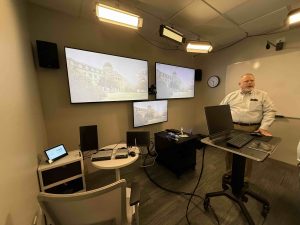 The challenge facing Jeff Jones, Executive Director of Teaching & Learning Innovation at Texas A&M’s Mays Business School, was both technical and perceptual. Faculty members recording distance learning content under standard fluorescent lighting appeared, in Jones’s words, “like ghosts” on camera. Virtual backgrounds caused washout issues with diverse hair types. The overall production quality offered no advantage over faculty teaching from home offices.
“We need a competitive advantage to show faculty we have something they can’t reproduce at home,” Jones explained.
The solution started with two pilot studios using PoE lighting arrays integrated with Zoom Rooms. The results—professional-quality output without the complexity of traditional broadcast control—generated campus-wide interest without requiring a sales pitch.
“The lighting did the speaking for me. Once we had two studios, the story spoke for itself.”
— Jeff Jones, Executive Director of Teaching & Learning Innovation

Current status: 9 distance learning studios operational, with plans to convert 8 into XR (extended reality) stages by 2029. The Bush School and campus libraries have already approached the business school team asking how to replicate the setup affordably.
Why PoE specifically mattered: Texas A&M operates in leased facilities. Running new electrical conduit required landlord negotiations and permit processes. Network drops, however, already existed in every room—PoE lighting installed into that existing infrastructure without triggering any facilities management approval cycles.
Gwinnett County Public Schools: 40+ studios, zero permits
Gwinnett County Schools in Georgia began with 23 studio locations, primarily for student-produced morning news broadcasts. When the district decided to scale, traditional lighting would have required fire marshal permits at each site—a process that varies by jurisdiction but typically adds 6 to 12 months per location.
PoE lighting fixtures weigh under 10 pounds and draw low-voltage power through network cables. Both characteristics kept the installations outside the scope of electrical permitting requirements. The district scaled from 23 to over 40 studio locations using the same standardized configuration at each site.
Orange County Public Schools: 197 schools deployed
Orange County Public Schools in Florida represents the longest-running scaled deployment, with the relationship dating to Ikan’s founding. Every school in the district—197 locations—now uses Ikan lighting. The district worked with Ikan to develop a single-login system for managing hundreds of teleprompter licenses centrally, eliminating individual school administration overhead.
Configuration approach: The district uses standardized “package” configurations—typically 5-6 lights per elementary school, 12+ per high school—allowing central purchasing to negotiate volume pricing while ensuring compatibility across all sites.
Corporate deployments: IT teams as the new customer
Corporate broadcast adoption in 2025 reflected a fundamental shift in who owns video production infrastructure. Where dedicated “video teams” once operated separately from IT, production responsibilities increasingly fall under IT department oversight. This matters because IT teams think in terms of network infrastructure, not broadcast-specific workflows.
Home Depot: 95% energy reduction, 60 minutes saved daily
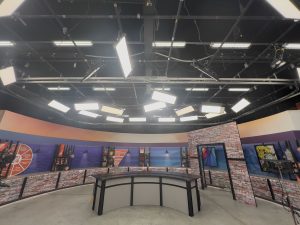 Home Depot’s Atlanta headquarters studio operated with legacy HMI and tungsten lighting consuming approximately 45kW per session. The heat output was so significant that it masked a 50-year-old HVAC system failure—the building literally hadn’t needed heating because the studio lights generated enough warmth.
Replacing the legacy fixtures with LED panel lights dropped power consumption to roughly 2.2kW per session—a 95% reduction.
The operational impact extended beyond energy costs:
- Pre-production setup previously required 60+ minutes of color matching and white balancing
- LED fixtures with high color rendering indices eliminated daily calibration requirements
- Engineers no longer climbed ladders to refocus lights between productions
- Content production capacity increased approximately 40% due to workflow efficiency gains
The 18-month ROI calculation focused solely on energy savings—operational efficiency gains and the resolved HVAC discovery weren’t included in the initial business case.
Whole Foods: From stage lighting to podcast studios
Whole Foods began using Ikan products for stage lighting at live events during the pre-PoE era. The current expansion adds PoE lighting with Q-SYS integration for town hall meeting spaces and a dedicated podcast studio. The transition illustrates a common scaling pattern: organizations start with a single use case, prove ROI, then expand to additional spaces using IP-based solutions that integrate with existing AV infrastructure.
Conference room opportunity: The volume play
Beyond dedicated studios, corporate deployments are expanding into standard meeting spaces. A typical corporate office building includes 10 to 50 conference rooms, huddle spaces, and breakout areas—most with drop ceilings and existing network infrastructure.
Adding 3-4 PoE lights to each room transforms video call quality without requiring dedicated studio construction. White-cased fixtures blend with ceiling tiles. Q-SYS or Crestron integration means lighting presets activate automatically when meetings start.
“If you put three or four lights in every one of those rooms—that’s 150 lights just for three lights per room across 50 spaces. That’s a lot of opportunity concentrated in places that already have network infrastructure.”
— Daniel Napier, Ikan Sales Leader
What made 2025 scaling different? Three technical enablers
1. PoE power delivery eliminated electrical dependencies
PoE++ technology delivers 60W to 90W through standard CAT6 cables—sufficient for broadcast-quality LED lighting. This removes the single largest source of deployment delay: coordinating electricians and waiting for permits.
Cost impact per room:
- Traditional electrical infrastructure: $10,000–$15,000
- Permit costs (where required): $6,000–$20,000
- Grid installation: ~$20,000
- PoE alternative: Standard network cabling only
Installation time comparison:
- Traditional studio build: 3-4 months minimum (often 12-18 months including permits)
- PoE-based installation: 1-5 days typical
2. Q-SYS integration opened the SI market
Broadcast systems integration represents a small fraction of the overall AV/IT integration market. According to Ikan leadership estimates, perhaps 1 in 100 system integrators—or fewer—specialize in traditional broadcast workflows with SDI, DMX, and linear baseband technology.
Q-SYS and Crestron platforms, by contrast, represent standard knowledge across the broader SI community. When broadcast lighting integrates with these platforms, the 99% of system integrators who already understand IP-based AV control can confidently specify and install the equipment.
“We built technology that not only made sense to future-proof corporations, but also allowed the integrators to feel comfortable using it, installing it, and working with it.”
— James Tian, CEO, Ikan International
Practical result: SIs can copy successful designs across multiple projects without relearning broadcast-specific workflows for each deployment.
3. Ecosystem approach reduced multi-vendor risk
Traditional broadcast installations often source cameras, lighting, teleprompters, pedestals, and tally systems from different manufacturers. Compatibility testing falls on the integrator—and when components from different vendors don’t work together properly, the SI absorbs the cost of troubleshooting and return visits.
Single-vendor ecosystem solutions shift compatibility responsibility to the manufacturer. Products designed and tested together install predictably, protecting both SI margins and client relationships.
“The biggest cost for an SI is having to use a third party and return visits. When you take four of those parties out of the loop, immediately, you’ve saved a huge amount of time and you’ve brought more money back into the SI.”
— Daniel Napier, Ikan Sales Leader
Studio Rover: Mobile production as a scaling entry point
For organizations uncertain about studio investment, mobile production units offer a different scaling path. The Studio Rover—a wheeled unit integrating PTZ camera, teleprompter, Q-SYS-ready lighting, and confidence monitor—earned Best of Show recognition at InfoComm 2025.
The business case: Rather than committing $2 million to a dedicated studio without knowing exact use cases, organizations can deploy mobile production capability, identify which teams actually use it, and scale permanent installations based on demonstrated demand.
Use cases extend beyond corporate communications: sports training facilities use mobile units for athlete self-assessment and coaching review. Medical facilities wheel production equipment between procedure rooms for training content. Legal applications include remote depositions where equipment travels to secure locations.
Why system integrators should pay attention
The convergence of broadcast and IT infrastructure creates both opportunity and risk for system integrators. Organizations increasingly purchase video production equipment through IT procurement channels rather than specialized broadcast vendors. SIs who remain focused exclusively on traditional AV installations may find their addressable market shrinking.
The opportunity: Adding broadcast-capable solutions to existing AV practices positions integrators to capture corporate studio projects without requiring deep broadcast expertise. IP-based equipment speaks the same language as the conference room systems, digital signage, and enterprise AV infrastructure that SIs already deploy.
The risk: Organizations with sophisticated IT teams may handle deployments internally or select integrators based on existing enterprise relationships rather than broadcast-specific credentials.
“If you don’t adopt and start getting involved with this technology, then your market share is going to start to get smaller. It’s a motion that’s started. It’s not going to go back.”
— Daniel Napier, Ikan Sales Leader
Industry recognition: 2025 awards
Ikan’s PoE and IP-based products received Best of Show recognition at both major 2025 trade events:
- InfoComm 2025 (largest U.S. AV trade show): Awards for PoE lighting, teleprompters, monitors, and Studio Rover
- IBC 2025 (largest European broadcast show): Recognition for PoE IP product innovations
These peer-reviewed awards validate that the simplified approach meets professional broadcast standards while delivering the installation and integration benefits that drive adoption.
Looking ahead: What 2026 deployments will require
Based on 2025 patterns, organizations planning broadcast infrastructure investments should expect:
Continued IT ownership: Video production increasingly falls under IT department responsibility. Solutions that integrate with existing network management and AV control platforms will win over broadcast-specific approaches requiring specialized expertise.
Automation requirements: As studios multiply but staffing remains flat, automation becomes mandatory. Q-SYS-controlled environments where non-experts can activate pre-configured lighting scenes, camera positions, and teleprompter scripts reduce the expertise barrier for content production.
AI integration: The next wave of simplification involves AI-assisted production and post-production workflows. Practical applications focus on reducing learning curves rather than replacing human operators.
Scale-in approach for uncertain organizations: James Tian’s recommendation for organizations unsure about studio investment:
“Start with a good camera, good lighting, and good audio. Those are the top three things you should scale into. A teleprompter could be the next thing you scale into—it gives presenters confidence in delivering their lines without memorization.”
Key takeaways
- PoE technology removes the permit and electrician dependencies that historically added 6-18 months to broadcast installations. Organizations scale by replicating proven configurations through existing network infrastructure.
- 2025 deployments proved enterprise-scale viability: Texas A&M expanded from 2 pilot rooms to 13 studios; Gwinnett County grew from 23 to 40+ locations without permits; Orange County Public Schools operates in all 197 schools.
- Corporate IT teams are the new customer for broadcast equipment. Solutions must integrate with Q-SYS, Crestron, and standard enterprise AV platforms to gain adoption.
- System integrators face a market shift: The 99% of SIs who understand IP-based AV can now confidently deploy broadcast solutions, while specialists who ignore IP convergence risk losing market share to IT-driven purchasing.
- Home Depot achieved 95% energy reduction and 18-month ROI through LED replacement of legacy tungsten/HMI lighting—demonstrating that efficiency gains extend beyond installation speed to operational costs.
- Mobile production units like Studio Rover offer organizations a path to prove use cases before committing to dedicated studio construction.
Related reading:
For more information on scaling broadcast solutions for your organization, chat with an Ikan pro today.