

One Button. Zero Expertise. Professional Results.
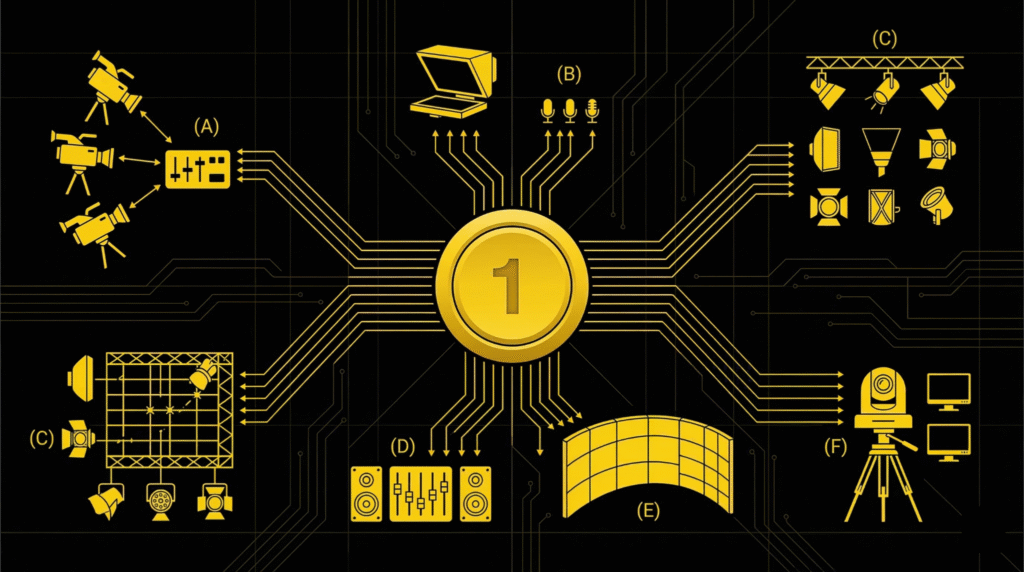
The Clients Who Will Never Hire a Broadcast Engineer
The National Pork Board needed to deliver crisis communications to an entire industry. Their existing setup was a basic camcorder. No production staff. No broadcast background. No plans to hire either.
Autodesk needed broadcast-quality video from conference rooms across twelve global offices. They already had Q-SYS infrastructure in place for AV, but nobody on staff who understood studio lighting or camera work.
Texas A&M’s Mays Business School runs nine distance learning studios where professors deliver graduate-level instruction. The faculty’s job is to teach. Not one of them was going to learn broadcast operations, and the university wasn’t going to staff nine studios with engineers.
Three completely different organizations. The common thread: every one of them represents the fastest-growing segment of broadcast investment—organizations that need professional production quality but will never build a traditional broadcast team to get it.
For system integrators, this is both the opportunity and the design challenge. These clients don’t evaluate your work the way a broadcast engineer would. They evaluate it by whether someone with zero technical training can walk into a room and produce professional content. If the answer is no, the system isn’t finished.
Designing Systems People Actually Use
The traditional integrator instinct is to build for maximum capability. More inputs, more routing options, more manual control. For professional broadcast facilities staffed by engineers, that instinct is correct.
For the National Pork Board, it would have been a disaster. Their team needed to deliver industry messaging during national crises—disease outbreaks, trade policy shifts, supply chain disruptions—with people whose primary expertise is agriculture, not broadcast production. The solution included sixteen studio lights with DMX control, three cameras, and a teleprompter system, but the critical deliverable wasn’t the equipment list. It was the operational manual and training that meant non-technical staff could run the studio independently.
Autodesk took a different path to the same destination. Their conference rooms already had Q-SYS infrastructure for AV management. The integration team deployed LBX8 PoE lighting—two per room, designed for drop ceilings—that plugged directly into the existing network. The Q-SYS plugin handles all lighting control. The result: one-button studio activation. Walk in, press the button, produce content. No lighting adjustment. No camera configuration. No technical staff required.
The numbers tell the SI story.
Zero permitting delays in an environment where traditional installations typically take six to twelve months through electrical permitting alone. A seventy-five percent reduction in installation time—one day per room versus three to four days with conventional wiring. And ten to fifteen thousand dollars saved per room in electrical infrastructure costs. Across twelve offices, those margins add up fast.
The Producer Model: Separating Content from Technical
Texas A&M’s approach represents a third operational architecture worth studying. Rather than automating away all technical operation or training faculty to run equipment, they built a producer system that completely separates content delivery from technical execution.
Faculty walk into a studio. A producer—drawn from backgrounds as varied as former teachers, makeup artists, and IT professionals—handles all setup. Thirty minutes of preparation. The professor focuses entirely on teaching. The producer manages cameras, lighting, and the technical workflow.
“There is something different about when you step into the studio. It’s a little bit more flip the switch, step into gear.”
— Amy Hurta, Lecturer, Mays Business School
The PoE lighting infrastructure was essential to making this model work at scale. Texas A&M operates in leased facilities where permanent electrical modifications aren’t practical. By running lighting through network drops instead of dedicated electrical circuits, they could outfit nine studios without triggering construction permits or altering the building’s electrical footprint. The two-week producer onboarding process confirms that the systems are genuinely operable by non-specialists.
For SIs, the Texas A&M model is a design template for any institutional client running multiple studios. The infrastructure has to be simple enough that producers—not engineers—can operate it reliably. And the installation has to be repeatable. Nine studios with consistent quality, and plans for eight XR conversions by 2029.
The Business Case for Simplicity-First Design
Clients who can’t operate a system don’t renew. They don’t expand. They don’t refer other departments. Every support call from a confused operator erodes the margin on that project.
The three deployments in this article suggest a different model.
National Pork Board went from a camcorder to a professional studio that non-technical staff run independently—delivering podcasts, presentations, green screen productions, and emergency broadcasts. Autodesk piloted one conference room and is now rolling the same configuration across twelve offices globally. Texas A&M’s studios generated enough campus-wide interest that the Bush School and university libraries are asking how to replicate the model.
“The Bush School and libraries are asking ‘How are y’all making these studios affordable?’”
— Jeff Jones, Executive Director of Teaching & Learning Innovation, Texas A&M
That’s the expansion pattern SIs should be designing for. Not a single-room sale, but a deployment architecture that proves itself with non-technical users and then replicates organically across the organization.
Three Design Principles for Non-Technical Deployments
First: build the operational workflow before the equipment list.
Who will operate this system daily? What do they already know? What will they refuse to learn? The National Pork Board’s comprehensive training manual and Autodesk’s one-button activation both started from the operator’s reality, not the equipment’s capability.
Second: use infrastructure as a simplification layer.
PoE lighting eliminates the permitting and electrical complexity that slows non-technical deployments. Q-SYS integration consolidates control into a single interface. Both reduce the number of things an operator has to understand.
Third: design for replication, not customization.
Autodesk’s conference room conversion model works precisely because every room gets the same configuration. Texas A&M’s nine studios use consistent equipment. Standardization is what makes non-technical operation reliable at scale.
The Next Wave of Non-Technical Broadcast Clients
The organizations profiled here aren’t outliers. They represent where institutional broadcast investment is heading—toward organizations that need professional production quality operated by people whose primary job is something else entirely. Agriculture communications. Software development. University instruction.
SIs who master simplicity-first design for these clients aren’t just winning individual projects. They’re building a repeatable practice in the fastest-growing segment of the market. The question is whether your current design approach passes the one-button test—or whether you’re still building systems that only an engineer could love.