

The NDI vs. SDI question still generates friction in 2026, and the reason has less to do with the technology than most people admit.
It’s a risk tolerance question dressed up as a technology question.
SDI represents a known quantity. A signal path that behaves predictably, fails in understood ways, and can be diagnosed with tools every broadcast engineer already owns. It has worked for decades, and the people who install and maintain it understand it deeply.
NDI represents a capability expansion. Video over the IP network infrastructure most organizations already have. But it introduces network design as a variable that didn’t exist in an SDI world—and that variable is governed by an IT team, not a broadcast team.
Neither protocol is universally superior. The question is: which one is right for this studio, this operator model, this infrastructure, and this risk profile? That’s what this article answers—with a decision matrix, scenario-specific recommendations, and an honest accounting of the hidden costs on both sides.
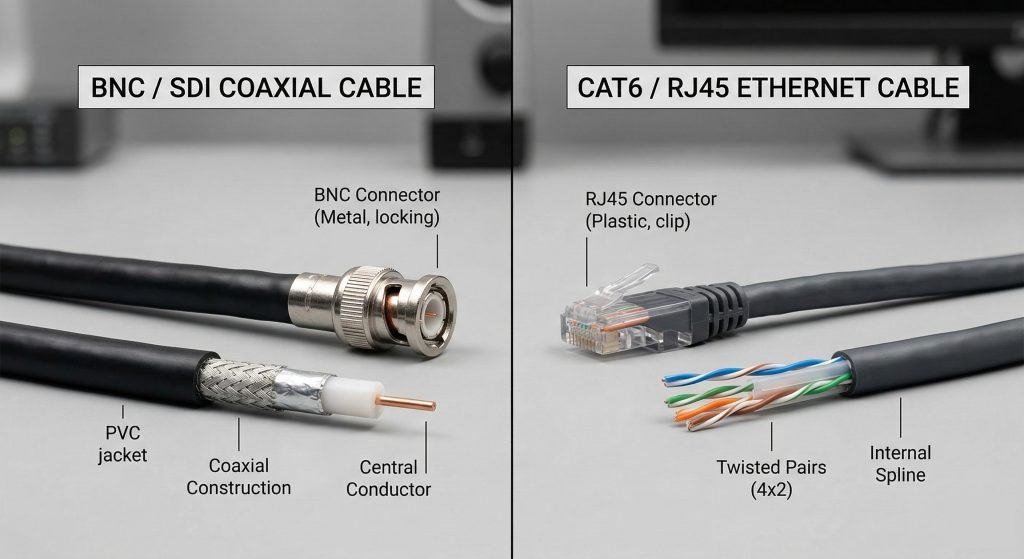
The plain-English difference
What SDI is
Serial Digital Interface is a dedicated coaxial cable standard designed specifically for video signal transport. In its standard form, the signal is uncompressed, deterministic, and point-to-point. One cable carries one video signal from one output to one input. The signal path is physical and fixed—you can trace it with your hand from the camera to the switcher. Troubleshooting is electrical: Is there a signal on the cable? Is the cable damaged? Is the connector seated properly?
What NDI is
Network Device Interface is a protocol—originally developed by NewTek (now Vizrt)—that carries video, audio, and metadata over standard IP networks using Ethernet and TCP/UDP. The signal path is logical, not physical. Multiple video streams can share the same network infrastructure simultaneously. Routing is software-defined: changing which display shows which camera feed is a software operation, not a cable swap. Any device on the network can discover and receive any NDI stream, subject to permissions and bandwidth availability.
The key architectural difference
SDI is a dedicated infrastructure built specifically for video. NDI treats your existing network as video infrastructure. That single distinction drives almost every tradeoff in this comparison—from installation cost to troubleshooting complexity to scalability.
Where SDI still wins
SDI is not outdated, and in many environments it remains the correct choice. Dismissing it as “legacy” misreads how and why it’s deployed.
Predictable, deterministic signal path. SDI either works or it doesn’t. There’s no “it mostly works but drops frames during peak network traffic.” Diagnosing a failure is mechanical: check the cable, check the connector, check the device output. There is no network congestion variable, no QoS configuration to maintain, and no IT team to coordinate with.
Simpler in small, fixed installations. A single-camera, fixed-format studio with no plans to scale doesn’t benefit meaningfully from NDI’s routing flexibility. SDI is sufficient, simpler to maintain, and easier to hand off to a client who has basic broadcast knowledge.
Known troubleshooting patterns. Every broadcast engineer trained in the last 30 years knows how to debug SDI. Cable testers, waveform monitors, and signal generators are standard toolkits. NDI troubleshooting requires network diagnostic skills—packet capture, multicast analysis, QoS verification—that are not universal on broadcast teams.
No network dependency. SDI does not require a functioning, properly configured IP network. In environments where IT governance over the network is complex, unpredictable, or slow-moving, SDI removes a critical dependency from the AV project.
Low latency, uncompressed signal. For applications where frame-accurate sync and uncompressed signal quality are non-negotiable—multi-camera live switching with genlock, broadcast contribution feeds—SDI’s baseline performance characteristics are well-understood and trusted.
Where NDI wins—especially for corporate and institutional studios
NDI’s advantages become concrete, not theoretical, in specific deployment scenarios. These are the environments where the protocol delivers measurable operational value.
Video routing over existing IP infrastructure. Organizations that already have structured Cat6 or fiber networks don’t need to run dedicated coaxial cable. In retrofit environments, leased spaces, and buildings where new cable runs require permits or landlord approval, this is a significant deployment advantage. The infrastructure already exists—NDI uses it for video transport.

Software-defined routing. Changing a signal path in an NDI system is a software operation, not a physical re-patch. For multi-room or multi-destination deployments, this dramatically increases operational flexibility. Adding a new display destination or switching which room receives which camera feed happens in software, without touching a cable.
Scalability at lower marginal cost. Adding a camera or a display destination to an NDI system is largely a software and network-capacity task. Adding to an SDI system requires a new physical cable run from source to destination. The cost difference compounds as room count and endpoint count grow.
Integration with IP control ecosystems. In environments already running Q-SYS, the alignment between IP video (NDI), IP lighting (PoE lighting as part of a unified IP studio architecture), and IP control (Q-SYS) creates a genuinely unified architecture where every component speaks the same infrastructure language. That integration is described in detail in the Q-SYS integration in IP-native studio environments guide.
Remote production capability. NDI streams can traverse wide-area networks with appropriate infrastructure, enabling remote operators, multi-site contribution, and off-site monitoring without dedicated video transport infrastructure.
For corporate deployments where bandwidth efficiency matters, NDI HX3 delivers high-quality video at compressed bitrates suitable for standard gigabit network infrastructure. The Ikan OTTICA FHD-20X PTZ camera supports selectable NDI High Bandwidth and NDI HX3 modes—along with HDMI and SDI outputs—giving SIs the flexibility to deploy the same camera in both NDI and SDI workflows depending on the project requirements.
The hidden costs people ignore
A surface-level comparison stops at the protocol specs. An experienced integrator knows the real cost differences show up in infrastructure, staffing, and ongoing operations. This section covers what both sides of the ledger actually look like.
Hidden costs of SDI deployments
Cable plant cost scales linearly with camera count and cable run length. In large or multi-room deployments, dedicated coax runs become a significant line item. Physical patching infrastructure—routing switchers, patch panels, distribution amplifiers—adds cost and complexity. And reconfiguration requires physical labor. Moving a camera feed from one room to another means running a new cable, not reassigning a software route. That inflexibility is a cost that compounds over the life of the installation.
Hidden costs of NDI deployments
Network design is not optional. NDI requires a properly configured, bandwidth-adequate, QoS-prioritized network. In organizations where IT governs the network and AV doesn’t, this introduces a coordination cost—sometimes a significant one. The IT team needs to be engaged, supportive, and involved from project kickoff. This matters because transport decisions directly affect automation reliability (Article 9 in this series).
The troubleshooting skill set is different. NDI issues—dropped frames, latency spikes, multicast flooding—require network diagnostic tools and knowledge that not every AV team possesses. SIs need either in-house networking expertise or a reliable IT partner at the client site.
Monitoring infrastructure is an ongoing investment. IP video streams need network-layer monitoring to catch problems proactively, not just reactive troubleshooting when something breaks during a broadcast.
The hidden cost most commonly overlooked: staff skill continuity. If the one person who understands the network configuration leaves, NDI systems can become opaque to the remaining team. Documentation and training are non-optional investments.
For both protocols
Redundancy architecture costs real money regardless of protocol choice. SDI redundancy means spare cables and backup signal paths. NDI redundancy means network redundancy, failover routing, and potentially dual-NIC configurations. Neither is free—but the engineering approach differs, and neither should be skipped for mission-critical applications.

The decision matrix: pick your protocol in 5 questions
Answer these five questions about your specific project. Where most of your answers land determines your recommended protocol direction.
| Question | Answer favoring SDI | Answer favoring NDI |
|---|---|---|
| Do you have existing IP network infrastructure? | No—new cable plant needed either way | Yes—leverage existing network investment |
| Is your IT team involved and supportive? | No IT partnership; AV team owns everything | Yes—IT can support network-layer requirements |
| Do you need 3+ destinations or multi-room routing? | No—single room, fixed format | Yes—multi-room, multi-destination, scalable |
| Are your operators non-technical staff? | Operator has broadcast training; familiar with SDI | No broadcast training; simpler IP-based UX preferred |
| Do you anticipate scaling within 3 years? | No—fixed, defined scope | Yes—growth expected; flexibility matters |
Reading the matrix: If most of your answers fall in the SDI column, start with SDI and consider a hybrid path if needs change. If most fall in the NDI column, design for NDI with proper network planning from the start. Mixed answers across both columns point toward a hybrid architecture—covered in the next section.
Hybrid architectures: what real studios actually look like
Most production-grade studio builds in 2026 aren’t purely one protocol or the other. Hybrid architectures are common, practical, and often the most resilient approach.
SDI at the camera, NDI at the router. PTZ cameras output SDI. An SDI-to-NDI converter bridges the signal to the IP network for distribution and switching. This preserves SDI’s reliability at the source while gaining NDI’s routing flexibility downstream. It’s the most common hybrid pattern in corporate retrofits.
NDI for internal routing, SDI for external delivery. Video is managed over NDI within the facility—routing between rooms, feeding to displays, streaming internally. Output to traditional broadcast distribution infrastructure (satellite uplinks, broadcast trucks, cable contribution) uses SDI. The internal workflow gets NDI’s flexibility; the external handoff uses the format the receiving end expects.
NDI cameras on isolated VLAN, SDI backup path. For mission-critical broadcasts, a parallel SDI backup path is maintained even in primarily NDI environments. The NDI path handles day-to-day production. The SDI path activates only if network issues arise during a live broadcast. Belt and suspenders—for the situations where failure isn’t acceptable.
Cameras like the Ikan OTTICA FHD-20X are designed for exactly this flexibility—selectable NDI High Bandwidth, NDI HX3, HDMI, and SDI outputs on the same unit. The SI doesn’t have to commit to a single protocol at the camera level; the camera participates in whichever workflow the project requires.
What to choose in 2026: recommendations by scenario
Scenario 1: Corporate training room converted to studio
Single room. Non-technical operators. Existing network infrastructure. No electrical budget for new cable plant.
Recommendation: NDI. The existing network handles video transport without new cabling. Non-technical operators benefit from IP-based integration with Q-SYS automation—PoE lighting, NDI cameras, and control surfaces all on the same network. This is the deployment model where NDI’s advantages are most concrete.
Next step: Audit the existing network for bandwidth capacity and switch capabilities. Start with the complete corporate studio planning framework (Article 1) and build your first automated workflow around NDI sources.
Scenario 2: New-build dedicated broadcast facility with dedicated staff
Purpose-built space. Full electrical scope already in the project. Broadcast-trained operators on staff.
Recommendation: SDI or hybrid. If the facility is being built with a dedicated cable plant anyway, SDI’s operational simplicity and your team’s existing familiarity are genuine advantages. Consider NDI for routing flexibility if multi-room distribution is anticipated or if Q-SYS is the control platform—the IP integration advantages remain real even when the infrastructure argument is neutral.
Next step: Map the control architecture first. If Q-SYS is the platform, NDI cameras integrate natively and simplify the control design. If a separate broadcast router is already specified, evaluate whether NDI’s flexibility justifies the network design investment.
Scenario 3: Multi-room enterprise deployment
Campus, multi-site, or district-scale. Standardization across locations. Centralized management priority.
Recommendation: NDI with proper network design. Every routing advantage compounds at scale. Software-defined signal paths across 10, 20, or 40+ rooms eliminate the cable-run costs that would make SDI prohibitive. Centralized monitoring and firmware management across all endpoints run over the same network. Secure IT partnership before project kickoff—network design is non-optional at this scale.
Next step: Pilot one or two rooms. Validate network performance, document the configuration, then standardize and scale. For the full planning methodology, start with building a corporate video studio from the ground up.
Scenario 4: Live event or mission-critical broadcast
CEO address to investors. Public-facing livestream. Board meeting where failure is not an option.
Recommendation: Hybrid with SDI fallback. NDI for primary routing and operational flexibility. Parallel SDI backup path for the mission-critical output. Do not rely on a single network path for a live broadcast without a tested fallback—and “tested” means rehearsed under real conditions, not assumed to work because it was configured correctly.
Next step: Define the specific failure scenarios and the fallback procedure for each. Document them. Rehearse the switchover. The backup path has no value if the operator doesn’t know it exists or how to activate it.
Ready to make the call? Talk to an expert—NDI/SDI architecture consult.
SDI vs. NDI: core comparison for studio deployment
| Evaluation dimension | SDI | NDI |
|---|---|---|
| Signal transport | Dedicated coaxial cable | Standard IP network (Cat6/fiber) |
| Infrastructure | Dedicated cable plant | Existing or planned IP network |
| Permitting | May require conduit and electrical work | Uses existing network—typically no additional permits |
| Signal path type | Physical (point-to-point) | Logical (software-defined routing) |
| Routing flexibility | Limited by physical infrastructure | High—software reconfigurable |
| Scalability | Linear cost with cable runs | Lower marginal cost per endpoint |
| Troubleshooting | Broadcast engineering (electrical/signal) | Networking (IP, QoS, multicast) |
| Typical failure modes | Cable damage, connector failure, signal loss | Network congestion, misconfiguration, multicast flooding |
| Latency | Very low (deterministic) | Low to moderate (network-dependent; HX3 optimized for efficiency) |
| IT team involvement | Minimal | Required—network design and governance |
| Q-SYS / IP control | Possible with bridging | Native—same IP infrastructure |
| Best for | Fixed broadcast facilities, broadcast-trained staff, mission-critical with SDI infrastructure | Corporate, education, multi-room, IP-native environments, non-technical operators |
Frequently asked questions
What is NDI and how does it work?
NDI (Network Device Interface) is a royalty-free protocol developed by NewTek (now Vizrt) that enables video, audio, and metadata transmission over standard IP networks. Instead of dedicated coaxial cables, NDI sends video data as network packets over Ethernet. Any NDI-enabled device on the network can discover and receive streams from any other NDI device automatically. The protocol supports multiple simultaneous streams across a single network, with routing handled in software rather than through physical cable connections. NDI comes in several variants: NDI High Bandwidth (minimal compression, high quality, high bandwidth demand) and NDI HX3 (efficient compression for standard gigabit networks with quality suitable for most corporate and educational productions).
Do I need a special cable for NDI?
No. NDI runs over standard Ethernet network infrastructure—the same Cat6 cabling used for office networking, VoIP phones, and wireless access points. There is no “NDI cable.” What matters is the quality of your network switch (managed, with sufficient bandwidth and QoS support), the cable category (Cat6 for gigabit speeds), and whether the switch supports PoE if you’re also powering cameras or lights over the same cable.
Is SDI better than NDI for live production?
It depends on the production environment. SDI offers deterministic latency and an uncompressed signal path, which matters for frame-accurate multi-camera switching in traditional broadcast facilities. NDI offers routing flexibility and IP-based integration that corporate and institutional environments typically value more than sub-frame latency differences. For mission-critical live broadcasts, many studios use a hybrid approach: NDI for primary routing and flexibility, with an SDI backup path for the actual live output.
Can I mix NDI and SDI in the same studio?
Yes. Hybrid architectures are common and often the most practical approach in 2026. SDI-to-NDI converters bridge the two protocols. Cameras like the Ikan OTTICA FHD-20X offer both SDI and NDI outputs on the same unit, letting you choose per-destination rather than per-camera. The most common hybrid pattern: SDI at the camera for source reliability, NDI on the network for routing flexibility.
What does my network need to support NDI?
At minimum: a managed gigabit Ethernet switch with QoS (Quality of Service) support to prioritize video traffic over other network data. VLAN segmentation is recommended to isolate AV traffic from corporate IT traffic. Bandwidth planning should account for each NDI stream’s requirements—which vary by variant and resolution. IGMP snooping should be enabled if using multicast delivery. A dedicated AV network segment or a properly configured shared network with QoS prioritization are both viable approaches. [Editor: verify specific bandwidth-per-stream figures against current NDI documentation before publishing.]
Does NDI work with Q-SYS?
Yes. NDI integrates within Q-SYS control environments, particularly when paired with IP cameras and PoE lighting on the same network infrastructure. NDI cameras appear as network video sources that can be routed, switched, and controlled through the Q-SYS platform. Combined with Ikan’s certified Q-SYS lighting plugin, this creates a unified IP architecture where video, lighting, and audio all share the same control system and network infrastructure. See the Q-SYS integration in IP-native studio environments guide for a detailed walkthrough.
Key takeaways
- NDI vs. SDI is a deployment decision, not a technology contest. The right answer depends on your infrastructure, operator model, IT partnership, and scale requirements—not on which protocol is “newer.”
- SDI remains the right choice for fixed broadcast facilities with existing infrastructure, broadcast-trained operators, and environments where network dependency is a risk you can’t accept.
- NDI delivers the most value in corporate, education, and multi-room environments where existing IP infrastructure, software-defined routing, and Q-SYS integration create measurable deployment advantages.
- Hybrid architectures are the norm, not the exception. Most real-world studio builds in 2026 use elements of both protocols, matched to specific signal paths and reliability requirements.
- The hidden costs matter more than the protocol specs. Network design for NDI, cable plant for SDI, staff skill continuity for both—these are the line items that determine real project cost.
- Use the five-question decision matrix to move from analysis paralysis to a specific, defensible protocol recommendation for each project.
Need help making the call? Schedule an NDI/SDI architecture consult—our team can evaluate your infrastructure, recommend a protocol strategy, and support your system integrator through design and commissioning.